
Last updated on November 10th, 2026
Picture a jar of bubbly, lively starter sitting on your counter, ready to turn simple flour and water into warm, crusty homemade sourdough. A rye flour sourdough starter is one of the quickest, most dependable ways to get there. Rye is loaded with natural enzymes and nutrients that wake up wild yeast fast, so you’ll see signs of life sooner and end up with a starter that stays strong. Keep reading to find out why rye works so well, how to build your starter day by day, how to feed it, how to tell when it’s ready, and how to handle any hiccups.
What Is a Rye Flour Sourdough Starter?
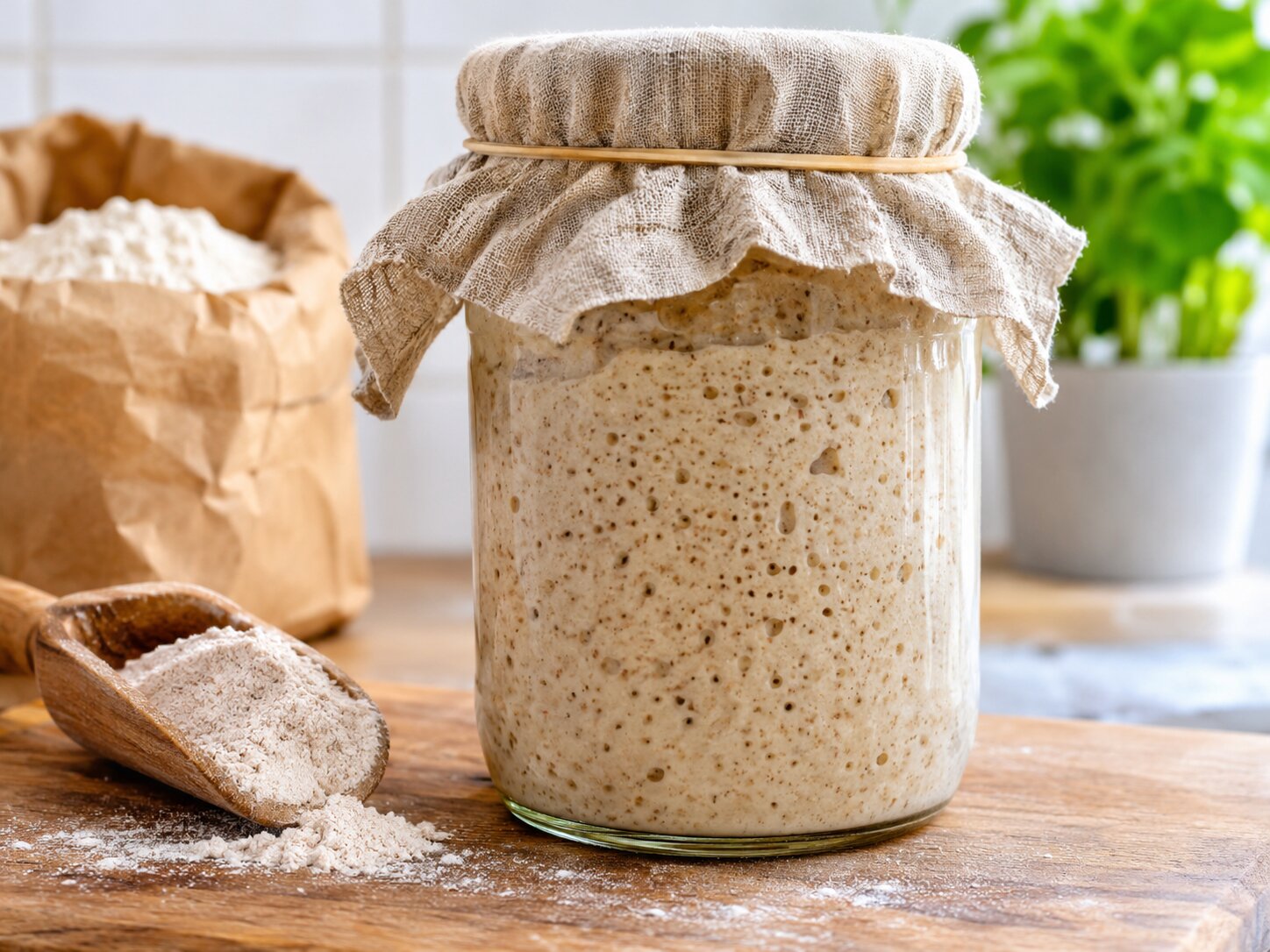
A rye flour sourdough starter is a living culture of wild yeast and lactic acid bacteria that you grow from nothing but whole rye flour and water. Those microbes already live on the grain, and you’re just giving them food and a home. As they eat the flour’s sugars, the yeast releases carbon dioxide, which makes bubbles and makes the starter rise. The bacteria produce lactic and acetic acids, which add tang and keep unwanted microbes out. Once that activity is strong and predictable, you’ve got a natural leavening agent for bread.
Don’t confuse a rye starter with rye sourdough bread. The starter is the culture you feed with rye flour. Rye bread is a loaf made mostly with rye flour. A rye starter can raise a white loaf, too.
Why Use Rye Flour for Sourdough Starter?
Whole rye flour gives wild yeast and bacteria nearly everything they need. Because the bran and germ are milled in, it has more minerals and nutrients than refined flour. It also carries a larger population of the microbes that live on the grain’s outer layers.
Rye is also rich in enzymes. Even unsprouted rye flour has a relatively high amount of amylase enzymes, which break starch down into sugar, compared with wheat flour, and rye has more free sugars than wheat, so it ferments faster. More fermentable carbohydrates are ready to eat right away, so a rye starter often shows bubbles and rises within the first few days. That early activity also makes it easier to tell you’re on the right track.
All-purpose flour has had its bran and germ removed, so it ferments more slowly. Whole wheat sits in the middle. It keeps its bran but usually can’t match rye’s enzyme activity. A slower wheat starter isn’t less healthy, though. Wheat flour just takes longer to reach peak ripeness.
Rye does have trade-offs. It’s stickier, builds little gluten, and adds an earthier, tangier flavor. If you want a fast, reliable start, it’s tough to beat.
- Rye: Fastest start, most enzymes and minerals, sticky texture
- Whole wheat: Steady activity, milder flavor, moderate enzymes
- All-purpose: Slowest start, mildest flavor, easiest to stir
Related: Rye Bread vs Sourdough: Which One Is the Healthier Option?
Ingredients and Equipment You Need
Here’s everything you need for the full two-week build:
- Whole rye flour: about 2–2.5 lb (1–1.1 kg) total
- Clean, drinkable water: about 1–1.1 kg, lukewarm (75–80°F)
- Clear glass jar: at least 1 quart
- Digital kitchen scale: for accurate feedings
- Loose-fitting lid or coffee filter: lets gas escape
- Rubber band or marker: tracks the rise
How to Make a Rye Flour Sourdough Starter
Day 1 – Mix Rye Flour and Water
Weigh out 50 grams of whole rye flour and 50 grams of lukewarm water. Stir until there are no dry streaks left. Rye absorbs a lot of water, so you’ll end up with a thick, sticky paste. That’s exactly what you want.
Scrape it into your clean jar, smooth the top, mark the level, and rest the lid loosely on top. Set it somewhere warm, around 75°F, away from drafts and direct sun, and leave it alone for 24 hours.
Days 2–3 – Look for Early Fermentation Activity
Check your jar each morning. You might spot a few bubbles, a slightly domed surface, or a tangy, slightly cheesy smell. Each day, stir in another 50 grams of rye flour and 50 grams of water, and mark the new level.
Some starters rise dramatically on Day 2, then go quiet on Day 3. That’s normal. The early burst often comes from Leuconostoc bacteria, not yeast, and the starter goes quiet because the pH has fallen and those gas-producing bacteria stop growing. The acidity they leave behind helps wild yeast take hold. Keep feeding on schedule.
Days 4–7 – Establish Regular Feedings
Now you start discarding. Once a day, remove all but 50 grams of starter. Add 50 grams of fresh rye flour and 50 grams of water, mix well, and mark the level.
Discarding keeps the ratio of fresh food to microbes high and keeps the volume manageable. Over these days, the paste should turn spongier, the smell should shift from funky to pleasantly sour, and small bubbles should spread through the whole mass instead of just the surface.
Days 8–14 – Build Starter Strength
Keep feeding once or twice a day. Switch to twice if it peaks within about 12 hours. You’re looking for a steady pattern: it rises after each feeding, peaks, and begins to fall on a predictable timeline.
Don’t worry if it’s still unpredictable on Day 14. Cool kitchens, low-quality flour, or skipped feedings can push maturity to three weeks or longer. Keep feeding consistently, and it’ll get there.
Rye Sourdough Starter Feeding Schedule
At room temperature (70–75°F), feed a rye starter once or twice every 24 hours. Rye ferments quickly, so it often uses up its food faster than a wheat starter.
Feeding ratios are written as starter:flour:water by weight. A 1:1:1 feeding uses equal amounts, like 50 g starter, 50 g flour, and 50 g water, and it peaks fast. A 1:2:2 feeding doubles the food, like 25 g starter, 50 g flour, and 50 g water. It takes longer to peak and works well in warm kitchens.
To work out your quantities, multiply your starter weight by each number in the ratio. With 20 g of starter at 1:2:2, add 40 g flour and 40 g water. Planning a bake that needs 150 g of active starter? Aim for about 175 g total and work backward: 35 g starter, 70 g flour, 70 g water.
Temperature controls the speed. At 78°F, a rye starter may peak in about four hours. At 65°F, it can take ten or more.
Feed more often if your starter peaks and collapses long before the next feeding, smells strongly of acetone, or needs building up before a bake.
Discard before every maintenance feeding to control volume and acidity. Skip the discard only when you’re building extra starter for a large bake.

How to Tell When Your Rye Starter Is Ready
Your starter is ready when it behaves the same way, feeding after feeding. Look for these signs:
- Bubbles throughout: You should see bubbles through the glass from top to bottom, not just on the surface. A spoonful from the middle should look spongy and airy.
- A predictable rise: It rises reliably within the same window after each feeding, often 4 to 8 hours at room temperature. Rye builds little gluten, so the surface often cracks at its peak instead of forming a smooth dome. A rise of 50 to 100 percent is normal.
- A pleasant, sour aroma: A mature rye starter smells tangy, like plain yogurt, with hints of beer, cider, or cocoa. The sharp, funky smells from the first week should have faded.
- Repeatable activity: It hits these marks for two or three feedings in a row. That consistency matters more than the number of days on the calendar. A starter that doubled once on Day 6 and hasn’t since isn’t ready yet.
Skip the float test. You drop a spoonful of starter in water to see if it floats, but rye has little gluten to trap gas, so a perfectly active rye starter often sinks. A starter made with medium-to-high protein bread flour is more likely to float than 100% rye, yet a rye starter can still raise bread. Go by the rise, the bubbles, and the smell instead.
Common Rye Sourdough Starter Problems
- Not bubbling: Usually the kitchen is too cool. Below about 68°F, activity slows sharply, so move the jar somewhere warmer. Feed at the same time and in the same amounts every day, and give a young starter more time to develop.
- Not rising: Bubbles show fermentation, but a rise shows leavening strength. Rye traps less gas than wheat, so a 50 to 75 percent rise can still be healthy. If there’s no rise, switch to 1:2:2 feedings and keep it warmer.
- Unusual smell: Vinegar, parmesan, or nail polish remover smells are normal, especially when it’s hungry, and feeding usually fixes them. Pink or orange streaks, fuzzy mold, or a rotten smell that lingers after feeding mean contamination. Throw it out and start over.
- Liquid on top: That gray or brown liquid is hooch, the alcohol that hungry yeast produces. Pour it off for a milder flavor or stir it in for more tang, then feed. Very wet rye starters can also separate. Just stir.
- Too thick or runny: Rye absorbs more water than wheat, so a 100 percent hydration rye starter is naturally thick. If it’s too stiff to stir, add water 5 g at a time. If it’s soupy, use 5 to 10 g less water at the next feeding.
Related: Best Russian Sourdough Rye Bread Recipe
How to Maintain and Store a Rye Starter
If you bake several times a week, keep your starter on the counter and feed it at the same time every day. In kitchens above 80°F, it can peak and collapse within hours, so feed twice a day or use a larger ratio like 1:3:3.
If you bake once a week or less, use the fridge. Feed your starter, let it sit at room temperature for an hour or two, then cover it and refrigerate. Feed it once a week. Rye ferments quickly, so leaving it much longer can make it very sour and full of hooch.
To revive it, let the jar warm up for about an hour, then discard and feed as usual. One or two room-temperature feedings usually do the trick, though a long rest may take three. It’s back when it rises on schedule, bubbles throughout, and smells tangy rather than sharp.
- Label the jar with the date of the last feeding.
- Keep a small backup portion in the fridge.
- Switch to a clean jar every couple of weeks.
- Feed it a day before you plan to bake.
How to Use Rye Sourdough Starter for Baking
A rye-maintained starter can leaven bread made with almost any flour. When the starter is only a small part of the dough, its rye flavor stays in the background. You get rye’s reliability without a strong rye taste.
For rye sourdough bread, a rye starter builds a deep, earthy, tangy flavor. Its acidity also keeps rye’s amylase enzymes in check, which helps prevent a gummy crumb. Expect a dense, moist loaf that slices best the next day.
For white sourdough bread, mix the starter into a bread flour dough. You’ll get an open crumb with subtle complexity and no obvious rye flavor.
For whole wheat sourdough bread, combine the starter with whole wheat flour for a nutty loaf with a toasty crust. Both flours absorb a lot of water, so make the dough slightly wetter than you would for white bread.
Don’t toss your discard. Sourdough discard recipes turn it into tangy pancakes, crisp crackers rolled thin with butter, salt, and herbs, or quick pan-cooked flatbreads.
Rye, Set, Bake!
So there you have it: a rye flour sourdough starter is one of the easiest ways to get wild yeast working in your kitchen. Rye’s natural enzymes and nutrients give your starter a serious head start, and with a little patience and a steady routine, it’ll grow from a sleepy jar of paste into a bubbly, dependable powerhouse. Don’t sweat the quiet days, the odd smells, or a little liquid on top, because they’re usually easy fixes.
Go by what your starter is doing, not by what day it is. Once it’s thriving, you can keep it going for years and bake just about anything you’re craving. Grab that bag of rye and get started. Your best homemade bread is closer than you think.
FAQs
Is rye flour good for sourdough starter?
Yes, rye flour is one of the best choices for a sourdough starter. Whole rye is packed with enzymes, minerals, and easy-to-eat sugars that feed wild yeast and bacteria, so your starter often shows bubbles and a rise within the first few days. It’s a bit stickier than wheat and adds an earthy tang, but it’s fast, reliable, and super beginner-friendly.
Can you use 100% rye flour for sourdough?
Absolutely. You can build and feed a starter with 100% rye flour, and you can bake a 100% rye loaf, too. Rye builds very little gluten, so the bread comes out denser and moister than wheat sourdough, with a deep, earthy flavor. The starter’s acidity keeps rye’s enzymes in check, and a loaf pan helps the dough hold its shape.
How much rye flour to use in sourdough starter?
Start with 50 grams of whole rye flour and 50 grams of water. For regular feedings, use a 1:1:1 ratio of starter, flour, and water by weight, like 50 grams of each. Or try 1:2:2, which is 25 grams of starter plus 50 grams each of flour and water. Over a two-week build, you’ll use roughly 2 to 2.5 pounds of rye flour.