
Last updated on August 17th, 2026
Your dough looks perfect in the banneton, then falls flat the moment it hits the oven. Sound familiar? Overproofing gets blamed for every baking hiccup, but most of what home bakers “know” about it isn’t quite right, and those shortcuts are holding your loaves back. Trusting a rigid timer, a single poke test, or judging by looks alone only gets you so far. Here’s the good news: once you know what’s actually happening inside your dough, you can read it like a pro. These 9 overproofing myths, busted, will get you there.
What Does Overproofing Actually Mean?
Proofing isn’t a single moment; it’s a stage in a much longer fermentation story. From the second your sourdough starter meets flour and water, yeast and wild bacteria get to work, munching on sugars and pumping out carbon dioxide. That gas gets trapped in the gluten network, and that’s what makes your dough rise. Proofing is simply the final leg of that journey, the last rise before the loaf hits the oven.
If you’ve ever set a timer for your final proof and trusted it blindly, you’ve probably been burned before. Fermentation doesn’t run on a stopwatch; it runs on conditions. Temperature, hydration, starter strength, and even the flour you’re using all speed up or slow down how fast your dough ferments. So asking what overproofing really means is asking a bigger question: has the dough’s structure and gas retention crossed a point where it can no longer hold its shape well? That’s dough strength, fermentation activity, and volume working together, not a number on a clock. Knowing how to tell if dough is overproofed starts with watching the dough itself, not the timer.
Myth: Overproofing Happens Only When Dough Rises Too Much
A lot of bakers eyeball their dough, see it’s ballooned up, and declare it overproofed. But dough rise on its own doesn’t tell the full story. What actually matters is what’s happening inside that gluten network. Carbon dioxide builds up as yeast ferments, and as long as gluten strength can hold that gas, the dough looks great and bakes even better. Here’s where the myth falls apart: dough can look only moderately risen and still be in trouble, because the gluten network has already started to weaken from prolonged fermentation activity. On the flip side, dough can look dramatically puffed up and still be perfectly fine if the structure is strong.
Quick signs of overproofing to watch for beyond just size:
- A slack, jiggly texture when you nudge the bowl
- A surface that looks bubbly, shiny, or fragile
- Dough that spreads sideways instead of holding its shape
- A sour, boozy smell that’s stronger than usual
Related: How to Fix Overproofed Sourdough
Myth: A Specific Proofing Time Guarantees Overproofing
Recipes love to throw out proofing times like they’re gospel, but bulk fermentation and final proof both move at wildly different speeds depending on your kitchen. Room temperature alone can shift proofing time by hours; a dough proofing at 65°F is going to take its sweet time compared to one proofing at 80°F. Your sourdough starter’s strength and how much of it you use (inoculation) change everything, and hydration matters too, since wetter doughs tend to ferment quicker. Even the flour you choose changes the game; whole-grain flours ferment faster than refined white flour thanks to their extra nutrients.
What actually decides your proofing time:
- Room and dough temperature
- Starter strength and inoculation amount
- Hydration level
- Flour type (whole grain vs. refined)
- Dough size and shape
Myth: Overproofed Dough Always Collapses
Picture a soufflé that sinks the second you look at it wrong; that’s the image people have of overproofed dough. But that’s only true for weak gluten structures that can’t hold onto carbon dioxide anymore. A well-developed dough with a sturdy gluten network can hang onto its volume even after fermentation has gone too far, at least for a little while. It might look fine sitting in the banneton, then fall apart the second it hits the hot oven, giving you a flat, dense loaf with barely any oven spring. Don’t rely on “did it collapse” as your only checkpoint.
Ways overproofed dough can fool you:
- Holds its shape in the banneton, then flattens in the oven
- Looks tall and puffy but feels weak and jiggly
- Delivers minimal oven spring despite decent pre-bake volume
- Bakes up dense or gummy even though it looked “risen enough”
Myth: The Poke Test Always Tells You the Answer
The poke test is a classic for a reason; it’s fast, simple, and works often enough that bakers swear by it. Press a floured finger into the dough: springs back fast, it needs more time; springs back slowly and leaves a slight indent, it’s ready; doesn’t spring back at all, it’s likely overproofed. The problem is dough hydration, dough temperature, and even flour type change how dough responds to touch. A high-hydration dough behaves differently under your finger than a stiff, low-hydration one, even at the same fermentation stage.
Tips for a more reliable poke test:
- Test at the same dough temperature every time for consistency
- Adjust your expectations for high-hydration doughs; they feel softer
- Pair the poke test with a visual check of surface bubbles and jiggle
- Don’t rely on one poke; test in two or three spots
Myth: Overproofed Dough Must Be Thrown Away
Tossing an overproofed batch in the trash feels like the responsible move, but it’s often a waste of good dough. Overfermented dough usually still has plenty going for it, especially in recipes that don’t rely on a big, dramatic oven spring. Reshape it gently and bake it in a loaf pan, where the pan walls give it the support it needs to hold together. Or lean into the situation entirely and change the format completely.
Ways to rescue overproofed dough:
- Bake it in a loaf pan for extra structural support
- Press it flat and turn it into focaccia
- Stretch it thin for flatbread
- Top it and bake it as pizza dough

Myth: Refrigerating Dough Completely Stops Fermentation
Tossing dough in the refrigerator feels like hitting pause, but yeast and your sourdough starter don’t just clock out the moment the temperature drops. Cold fermentation, sometimes called retardation, dramatically slows enzyme and yeast activity, but it doesn’t shut it down completely. Given enough time, dough in cold proofing can absolutely overferment; it just takes a lot longer than it would at room temperature. This is part of why bakers love the fridge: that slow, extended fermentation builds more complex flavor, but it’s not a free pass to forget about your dough for a week.
Keep cold proofing on track with these tips:
- Don’t leave dough in the fridge indefinitely; set a rough time limit
- Check dough volume and texture every day or two on longer rests
- Let dough come back to room temp gradually before baking
- Remember flavor keeps developing even while rise slows down
Myth: Sourdough Can’t Overproof the Way Yeasted Dough Does
Some bakers assume sourdough is more forgiving because it ferments slower than dough made with commercial baker’s yeast. That slower pace does buy you a bigger window, but it doesn’t make sourdough immune. Wild yeast and bacteria in a sourdough starter still produce gas and break down gluten over time, just at their own pace. Given enough hours, especially in a warm kitchen, sourdough overproofs just as surely as any yeasted dough.
Keep sourdough honest with these checks:
- Don’t assume “slow” means “safe”; keep checking dough condition
- Adjust your fermentation window based on starter activity, not habit
- Watch closely on warm days; sourdough speeds up too
Related: Underproofed Sourdough? What You Need to Know
Myth: Adding More Flour Fixes Overproofed Dough
When dough feels slack and overfermented, it’s tempting to knead in extra flour to firm it back up. But that only masks the texture; it doesn’t rebuild the gluten network that’s already broken down from prolonged fermentation. The result is often a dry, dense loaf that bakes up worse than if you’d left the dough alone.
Better ways to handle slack dough than adding flour:
- Reshape with gentle folds instead of adding flour
- Choose a rescue format like focaccia or pan bread rather than fighting the texture
- Save flour adjustments for hydration issues, not fermentation issues
Myth: Only Bulk Fermentation Can Overproof, Not the Final Proof
Plenty of bakers watch bulk fermentation closely, then relax once the dough is shaped, assuming the final proof is low-risk. That’s a mistake. The final proof is still active fermentation, and dough can absolutely overproof during this stage even if bulk fermentation was spot on. In fact, the final proof is where a lot of overproofing actually happens, since it’s easy to get distracted once shaping is done.
Don’t let the final proof catch you off guard:
- Keep an eye on dough during the final proof, not just bulk fermentation
- Use the poke test again before baking, not only after bulk fermentation
- Factor room temperature into your final proof time, just like bulk fermentation
How to Tell Overproofing From Underproofing
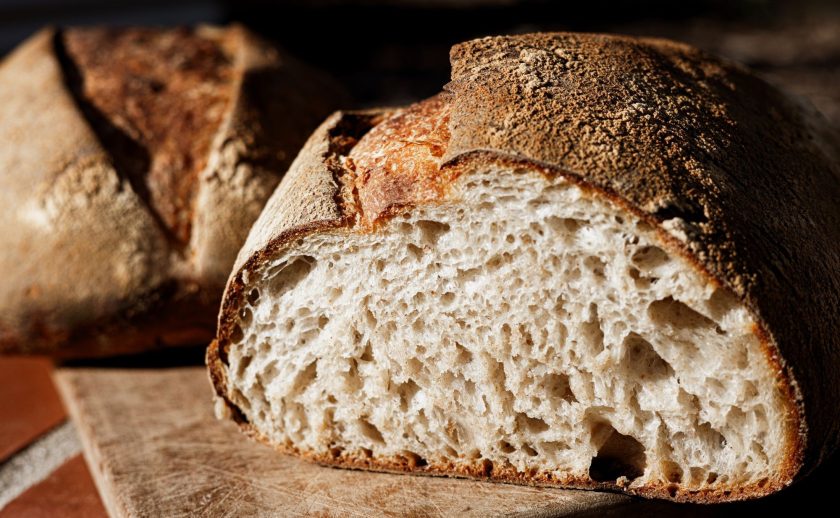
Underproofed dough tends to feel tight, springs back fast and fully when poked, and looks noticeably smaller than a fully fermented batch. Overproofed dough feels slack, barely springs back, and often has a slightly shiny, bubbly surface from gas activity pushing against a tiring gluten network. The oven is the ultimate lie detector: underproofed loaves get dramatic oven spring, sometimes blowing out at odd angles, and slice into a tight, dense crumb. Overproofed loaves fall flat, spread wide instead of rising up, and reveal a gummy or overly open crumb with irregular holes. Comparing volume, elasticity, and crumb side by side is the fastest way to figure out which direction you drifted, and it’ll teach you more about your own dough than any recipe timer ever could.
The Biggest Overproofing Myths, Debunked
- Myth: Overproofing happens only when dough rises too much. Fact: Structure and gluten strength matter more than visible size.
- Myth: A specific proofing time guarantees overproofing. Fact: Fermentation speed depends on temperature, hydration, and starter strength, not the clock alone.
- Myth: Overproofed dough always collapses. Fact: Strong gluten can mask overfermentation until it hits the oven.
- Myth: The poke test always tells you the answer. Fact: It’s a helpful clue, not a definitive verdict, especially across different hydration levels.
- Myth: Overproofed dough is a lost cause. Fact: Focaccia, pizza, and pan loaves happily welcome overfermented dough.
- Myth: Refrigeration stops fermentation. Fact: It only slows yeast activity way down.
- Myth: Sourdough can’t overproof like yeasted dough. Fact: It just takes longer, not never.
- Myth: Adding flour fixes overproofed dough. Fact: It masks the texture without rebuilding gluten strength.
- Myth: Only bulk fermentation can overproof. Fact: The final proof is active fermentation too, and it’s often where overproofing sneaks in.
At the end of the day, proofing is less about rigid rules and more about learning to read your dough, its texture, its structure, and how it behaves under your hands. The more loaves you bake, the more these signals start to click into place.
Trust the Dough, Not the Clock
Here’s the real takeaway: overproofing isn’t one mistake with one obvious sign; it’s a mix of time, temperature, and dough strength all working together. The poke test, the clock, and even a big rise can all mislead you if you read them alone. The real answer comes from getting to know your dough, its feel, its texture, how it behaves under your hands.
And even when things go too far, it’s rarely a total loss; there’s almost always a way to salvage it and still end up with something tasty. The fridge slows things down, but it doesn’t stop fermentation completely, so stay mindful even during a cold rest. Once you know what to look for, overproofing stops being scary and starts being just another skill you’ve got in your back pocket.
FAQs
Why is overproofing sourdough considered bad?
Overproofing weakens the gluten network past the point where it can hold gas and structure. That usually means poor oven spring, a flat or dense loaf, and a gummy, irregular crumb instead of that open, airy texture bakers chase. The dough’s still edible in most cases; it just won’t bake up with the height, chew, and structure you’re after.
What are the signs of overproofing?
Look for dough that’s slack and jiggly rather than springy, with a shiny, bubbly surface and a stronger sour smell than usual. It spreads sideways instead of holding its shape, and a poke test leaves an indent that barely bounces back. Weak resistance when you gently tug the dough is another tell that the gluten’s lost its strength.
Is it better to be overproofed or underproofed?
Underproofed, hands down. Underproofed dough still has plenty of gluten strength and fermentation left in the tank, so it bakes up with strong oven spring and a tight, even crumb, just less complex flavor. Overproofed dough has already lost structural integrity, so there’s less you can do to save it beyond reshaping into a more forgiving format.



![[video] from the seed to the peasant bakery with nicolas supiot](https://www.mydailysourdoughbread.com/wp-content/uploads/2022/11/image-16-120x120.jpeg "[Video – Part 2] Entering Into Peasant Bakery 7")
