
Last updated on October 22nd, 2026
Your kitchen thermostat has more control over your sourdough starter than your recipe does. A schedule that works in July can leave your starter sluggish and flat by January, and that’s not a flaw in your technique. It’s just how yeast and bacteria respond to heat.
If you’ve ever wondered why your starter doubled in four hours last week and took twelve hours this week, temperature is almost always the answer. Here’s what’s actually happening, and how to adjust your feeding routine around it.
Why Temperature Drives Everything in a Sourdough Starter
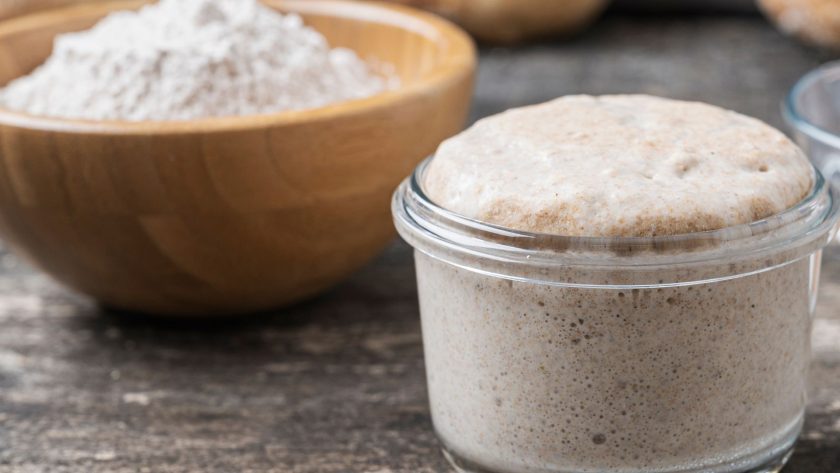
A sourdough starter is a living colony of wild yeast and lactic acid bacteria. Both organisms eat the sugars in flour and produce carbon dioxide (the bubbles that make your starter rise) and acids (the sour flavor). How fast they eat and reproduce depends almost entirely on temperature.
- Warmer temps speed up fermentation. Yeast and bacteria multiply faster, gas production ramps up, and your starter peaks sooner.
- Cooler temps slow everything down. Activity drags, rise times stretch out, and the starter can sit near its peak for much longer without collapsing.
- Bacteria and yeast don’t scale the same way. Lactic acid bacteria tend to thrive in slightly warmer conditions than yeast prefers, which is part of why a starter kept warm often tastes more sour or tangy than one kept cool.
This is the whole reason a fixed feeding schedule falls apart across seasons. A 1:1:1 ratio fed every 12 hours might be spot-on in a 78°F kitchen and completely wrong in a 65°F one.
Related: How Often Do You Feed Sourdough Starter
The Temperature-to-Feeding Chart
Use this as a starting point, not a rulebook. Every flour, water source, and starter has its own personality, so treat these as ranges to test against.
| Ambient Temp | Typical Peak Time | Feeding Frequency | Ratio to Try |
|---|---|---|---|
| Below 60°F (15°C) | 18-24+ hours | Once daily, or every other day | 1:2:2 or 1:3:3 |
| 60-68°F (15-20°C) | 10-16 hours | Once or twice daily | 1:1:1 or 1:2:2 |
| 68-75°F (20-24°C) | 6-10 hours | Twice daily | 1:1:1 |
| 75-82°F (24-28°C) | 4-6 hours | Twice daily, sometimes 3x | 1:2:2 or 1:3:3 |
| Above 82°F (28°C) | 2-4 hours | Every 4-6 hours | 1:4:4 or 1:5:5 |
A quick way to read this: hotter kitchens need bigger feedings (more flour and water relative to starter) to slow the pace down and avoid your starter blowing past its peak and collapsing before you’re ready to bake.
Colder kitchens need smaller, less frequent feedings because the starter simply isn’t burning through food as fast.
Adjusting Your Schedule Season by Season
Summer and Hot Climates
When your kitchen creeps above 78°F, your starter can peak in under four hours. That’s fast enough to catch people off guard, especially if you’re used to an overnight feed.
A few fixes that actually work:
- Increase your feeding ratio. Going from 1:1:1 to 1:3:3 or even 1:4:4 gives the yeast more food to work through, which stretches out the timeline without weakening the culture.
- Feed twice a day instead of once. Splitting feedings keeps the starter from over-fermenting and going liquidy or acidic between feeds.
- Move it to the coolest spot in the house. Away from the oven, off the counter near a sunny window, and out of direct sunlight entirely.
- Try cool water. Mixing your feed with cooler (not ice-cold) water can buy you an extra hour or two of stability.
Winter and Cold Climates
Below 65°F, fermentation slows to a crawl, which sounds like a hassle but actually works in your favor if your schedule is inconsistent.
- Stretch feedings to once every 24 hours, or even every 48 hours if the starter is healthy and just resting in the fridge between uses.
- Find a warm spot, not a hot one. On top of the fridge, inside a turned-off oven with the light on, or near (not on) a radiator all work.
- Use warm water in your feed, around 80-90°F, to give the starter a head start without shocking it.
- Consider the fridge for longer breaks. If you’re not baking for a week or more, refrigerating slows fermentation dramatically and you can feed just once weekly.
Spring and Fall (The Tricky In-Between)
These transitional seasons are where most people get thrown off, because the temperature swings day to day. The fix isn’t a new ratio, it’s just paying attention. Check your starter’s rise time every few days instead of assuming last week’s schedule still applies.
Signs Your Feeding Schedule Doesn’t Match the Temperature
- Too fast: Starter rises and falls before you’re ready to use it, has a strong alcohol or acetone smell, or develops a layer of dark liquid (hooch) quickly.
- Too slow: Starter barely rises, takes far longer than usual to show bubbles, or looks flat and lifeless days after feeding.
- On track: Consistent doubling within a predictable window, a pleasant tangy smell, and a domed or slightly peaked surface at its high point.
Related: Do you recognize the 3 early warning signs of underproofed bread?
A Simple Framework to Remember
Instead of memorizing exact hours, use this mental shortcut:
- Hot kitchen = feed more, feed bigger ratios, feed more often
- Cool kitchen = feed less, smaller adjustments needed, longer stretches between feeds
- Watch the starter, not the clock. Rise time and smell tell you more than any schedule printed on a blog.
FAQs
Does the type of flour change how temperature affects my starter?
Yes, somewhat. Whole grain and rye flours ferment faster than white bread flour at the same temperature because they contain more of the wild yeast and enzymes that fuel fermentation. If you switch flours, expect your timing to shift even if the room temperature stays the same.
What’s the ideal temperature range for a sourdough starter?
Most starters thrive between 70-82°F (21-28°C). Inside that range, you’ll get a reliable rise within a workable window without needing to babysit it constantly.
Can I use the microwave or oven light trick to warm my starter?
Yes, a turned-off oven with just the interior light on is a popular and effective trick, since it usually holds a steady 80-85°F. Just don’t forget it’s in there before you preheat the oven for baking.
Should I refrigerate my starter to slow it down?
If you’re not baking often, refrigeration is a solid option. Cold temperatures (around 35-40°F) slow fermentation enough that you can feed once a week instead of daily, though the starter will take longer to become fully active again once it’s back at room temperature.
How quickly should I adjust my schedule when the seasons change?
Give it a few days of observation rather than switching abruptly. Watch how long it takes to peak after a feeding, and adjust your ratio or frequency gradually until the rise time settles into a consistent pattern again.
Will an inconsistent temperature ruin my starter?
Not permanently. Sourdough starters are resilient and can bounce back from a stretch of neglect, temperature swings, or an inconsistent schedule. A couple of consistent feedings at the right ratio for your current environment is usually enough to bring it back to full strength.
Related Articles:
 Strawberry Cinnamon Rolls Recipe: A Sweet Twist on a Classic Favorite
 How Much to Feed Sourdough Starter (Beginner’s Guide)
 How to Feed Sourdough Starter from Fridge (Your Complete Guide to Better Bread)
 Why Is My Sourdough Starter Not Rising? (And How to Fix It)
 Can You Freeze Sourdough Starter? A Simple Guide to Saving Your Starter for Later
