Last updated on November 10th, 2026
When you’re craving something healthy and sweet, try this brilliant, and delicious sourdough cranberry bread. Featuring a good variety of dried fruits, earthy walnuts, and an orange for one of your five a day!
Toast a slice, add a swipe of butter, and breakfast is sorted.
The whole bake runs about 24 hours, but don’t let that scare you off. Your hands are only busy for around 45 minutes. The rest is your starter quietly doing the heavy lifting while you sleep, work or binge a show.
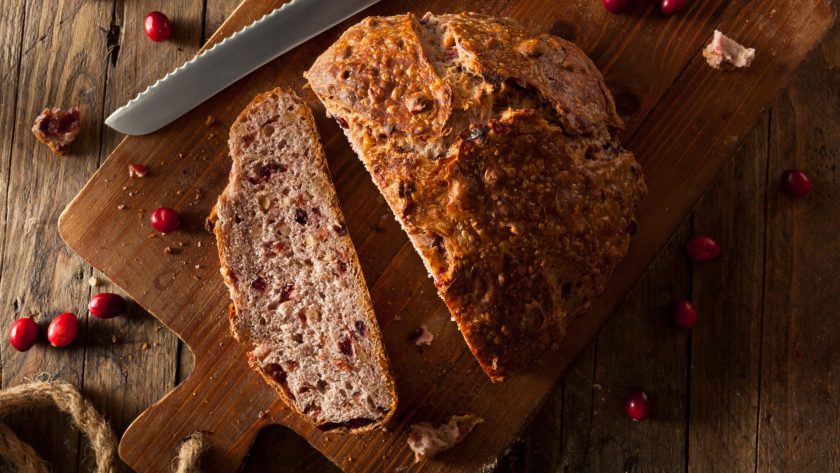
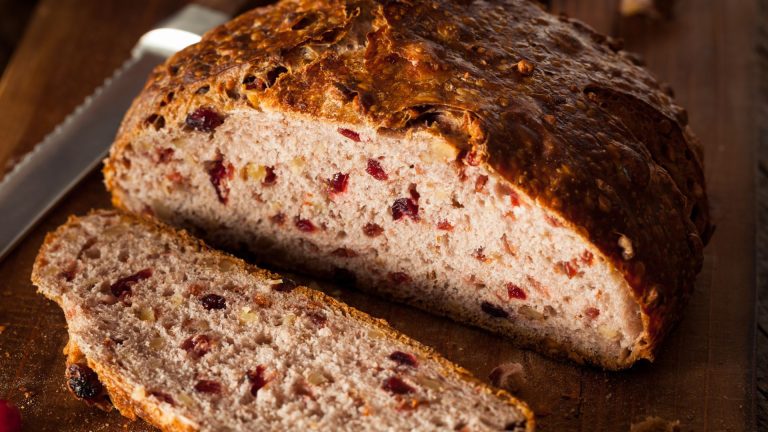
Walnut Cranberry Sourdough Bread Recipe
A chewy, crackly-crusted sourdough loaf packed with dried cranberries, toasted walnuts and fresh orange zest. It’s lightly sweet and great toasted with butter.
- Total Time: About 20 hours (plus 4 to 12 hours to feed your starter)
- Yield: 1 loaf 1x
Ingredients
For the dough
- 450 g (3 2/3 cups) bread flour
- 50 g (scant 1/2 cup) whole wheat flour
- 350 g (1 1/2 cups) lukewarm water, divided
- 100 g (scant 1/2 cup) active sourdough starter, 100% hydration
- 10 g (1 3/4 tsp) fine sea salt
- 20 g (1 tbsp) honey or maple syrup
- Zest of 1 medium orange
For the add-ins
- 100 g (3/4 cup) dried cranberries
- 40 g (1/4 cup) golden raisins or chopped dried apricots
- 80 g (3/4 cup) walnuts, toasted and roughly chopped
- Juice of 1 medium orange, for soaking
Equipment
- Digital kitchen scale
- Large mixing bowl
- 9-inch round banneton (proofing basket)
- 5 to 7 quart Dutch oven with lid
- Parchment paper
- Bread lame or sharp knife
Instructions
- Feed your starter 4 to 12 hours before mixing. Use it once it has doubled and looks bubbly.
- Prep the add-ins. Toast the walnuts at 350°F (175°C) for 8 to 10 minutes, then cool and chop. Soak the cranberries and raisins in the orange juice for 15 to 20 minutes, then drain well and pat dry.
- Autolyse. Mix both flours with 320 g of the water until no dry flour remains. Cover and rest 45 minutes.
- Mix. Add the starter, salt, honey, orange zest and remaining 30 g water. Squeeze and fold for 3 to 4 minutes until combined. Rest 30 minutes.
- Stretch and fold. Do 4 sets of stretch and folds, 30 minutes apart. Add the fruit and walnuts during the second set.
- Bulk ferment. Cover and let rise until the dough has grown 50 to 75%, looks domed and bubbly, and jiggles. This takes 4 to 5 hours at 75 to 78°F (24 to 26°C), longer in a cooler kitchen.
- Shape. Pre-shape into a loose round and rest 20 to 30 minutes. Shape into a tight boule, tucking any exposed fruit underneath. Place seam-side up in a banneton dusted with rice flour.
- Cold proof. Cover and refrigerate right away for 8 to 16 hours. Do not proof the shaped loaf at room temperature overnight.
- Preheat. Place the Dutch oven in the oven and preheat to 475°F (245°C) for 45 to 60 minutes.
- Score and bake. Turn the cold dough onto parchment, score, and lower it into the hot pot. Bake covered for 20 minutes. Uncover, reduce the oven to 425°F (220°C), and bake 22 to 28 minutes more, until deep golden and 205 to 210°F (96 to 99°C) inside.
- Cool. Let the loaf cool on a wire rack for at least 2 hours before slicing.
Notes
- Kitchen temperature matters. In a warm kitchen, end bulk at around a 50% rise. A loaf that rises too long will spread or collapse when you turn it out.
- Poke test before baking. Press a floured finger into the dough. A slow spring back with a small dent means it’s ready. A fast spring back means give it another 30 to 60 minutes at room temperature first.
- No Dutch oven? You’re going to need a Dutch oven for sourdough baking. If you don’t have one, bake on a preheated stone or heavy baking sheet. Pour a cup of boiling water into a tray on the rack below for steam, then remove the tray after 20 minutes.
- Swaps: pecans or pumpkin seeds instead of walnuts, or 1 tsp cinnamon added with the salt.
- Storage: keeps 3 to 4 days on the counter, cut side down. To freeze, slice it first and freeze for up to 3 months, then toast straight from frozen.
- Cook Time: 50 mins
- Category: bread, Breakfast
This Recipe, at a Glance
- Active hands-on time: about 45 minutes
- Bulk fermentation: 4 to 6 hours
- Cold proof: 8 to 16 hours (overnight in the fridge)
- Bake time: 45 to 50 minutes
- Makes: 1 large loaf, about 12 slices
- Skill level: beginner friendly, if you have an active starter
What is Cranberry Walnut Bread?
Cranberry walnut sourdough is a naturally leavened bread studded with dried cranberries and toasted walnuts. Instead of commercial yeast, it rises with a sourdough starter, which gives it a gentle tang, a chewy crumb and better keeping quality.
The flavor lands somewhere between a rustic country loaf and a fruit bread. It’s lightly sweet, a little tart and nutty.
This version adds orange zest and a handful of golden raisins for extra brightness, so each slice tastes like the holidays without being dessert-level sugary.
Why you’ll love it
- Barely sweet: just a spoonful of honey, with the fruit doing most of the work
- Flexible schedule: the overnight fridge proof fits around your day
- Great for gifting: it looks bakery-worthy on a cooling rack or wrapped in paper
- Goes with everything: butter, cream cheese, brie, turkey sandwiches or French toast
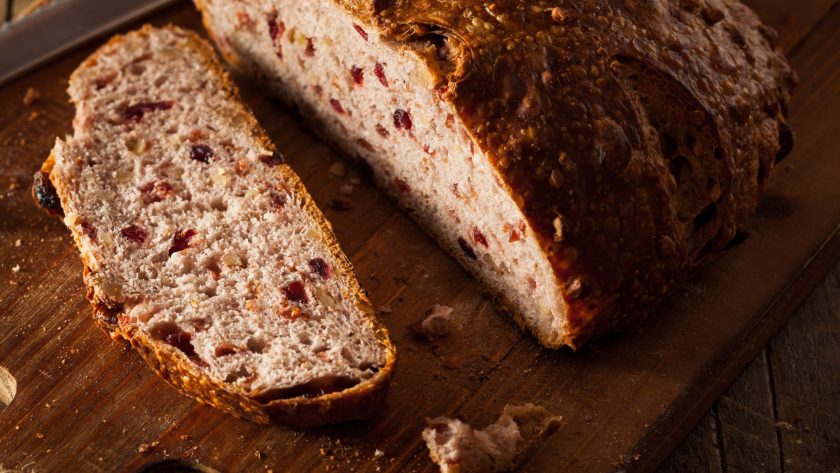
Ingredients for Sourdough Cranberry Walnut Bread
Weigh everything if you can. A digital scale makes sourdough far more predictable than cups, and the cup amounts below are close approximations only.
| Ingredient | Grams | Cups (approx.) | Baker’s % |
|---|---|---|---|
| Bread flour | 450 g | 3 2/3 cups | 90% |
| Whole wheat flour | 50 g | scant 1/2 cup | 10% |
| Water, lukewarm (about 80°F / 27°C) | 350 g | 1 1/2 cups | 70% |
| Active sourdough starter (100% hydration) | 100 g | scant 1/2 cup | 20% |
| Fine sea salt | 10 g | 1 3/4 tsp | 2% |
| Honey or maple syrup | 20 g | 1 tbsp | 4% |
| Dried cranberries | 100 g | 3/4 cup | 20% |
| Golden raisins or chopped dried apricots | 40 g | 1/4 cup | 8% |
| Walnuts, toasted and roughly chopped | 80 g | 3/4 cup | 16% |
| Orange (zest plus juice) | 1 medium | 1 medium | flavoring |
The total hydration lands around 73% once you count the water in the starter. That’s soft and workable, even for newer bakers.
Equipment
- Digital kitchen scale
- Large mixing bowl and a bowl scraper
- 9-inch round banneton or a bowl lined with a floured tea towel
- Dutch oven (5 to 7 quart) with a lid
- Parchment paper and a sharp knife or bread lame
- Instant-read thermometer (optional, but handy)
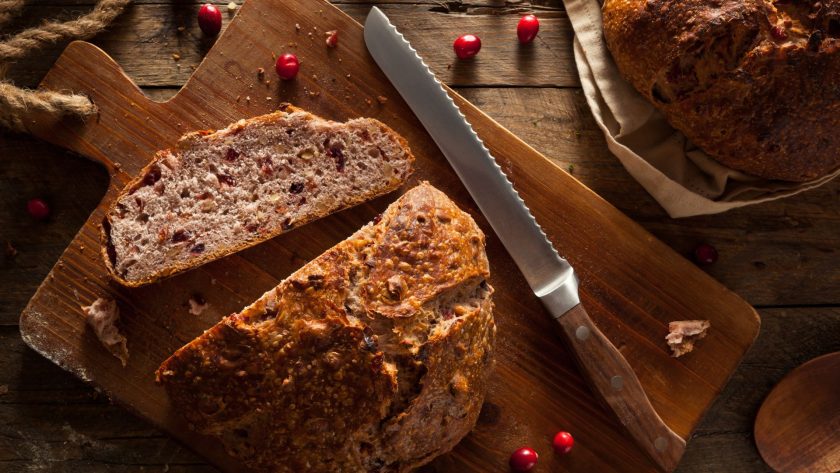
How to Make Sourdough Cranberry Walnut Bread
Here’s a sample schedule so you can see how the timing plays out. Shift it earlier or later to suit your day; just keep the gaps between steps roughly the same. These times assume a kitchen around 75°F (24°C). Cooler or warmer, check the bulk timing chart in Step 6.
| Day | Time | Step | Active time |
|---|---|---|---|
| Day 1 | 8:00 AM | Feed your starter | 2 min |
| Day 1 | 12:30 PM | Toast walnuts, soak fruit | 15 min |
| Day 1 | 1:00 PM | Mix flour and water (autolyse) | 5 min |
| Day 1 | 1:45 PM | Add starter, salt, honey, zest | 5 min |
| Day 1 | 2:15 to 3:45 PM | 4 sets of stretch and folds (fruit goes in at set 2) | 10 min total |
| Day 1 | 3:45 to 6:30 PM | Bulk rest until risen 50 to 75% | hands-off |
| Day 1 | 6:30 PM | Pre-shape, rest 20 to 30 min | 3 min |
| Day 1 | 7:00 PM | Final shape, into the fridge | 5 min |
| Day 2 | 7:00 AM | Preheat oven and Dutch oven | 1 min |
| Day 2 | 8:00 AM | Score and bake | 50 min, mostly hands-off |
| Day 2 | 11:00 AM | Slice and enjoy | the fun part |
Step 1: Wake up your starter
Feed your starter 4 to 12 hours before mixing. It’s ready when it has at least doubled, looks bubbly and domed, and smells pleasantly sour. Not sure? Drop a spoonful in water. If it floats, you’re good to go.
Step 2: Prep the fruit and nuts
- Toast the walnuts on a baking sheet at 350°F (175°C) for 8 to 10 minutes, until fragrant. Let them cool, then chop roughly.
- Zest the orange and set the zest aside.
- Juice the orange into a small bowl. Add the cranberries and raisins and soak for 15 to 20 minutes.
- Drain the fruit well and pat dry with a paper towel.
Soaking stops the dried fruit from stealing moisture from your dough, which keeps the crumb soft.
Step 3: Mix the flour and water (autolyse)
In a large bowl, mix both flours with 320 g of the water until no dry bits remain. Hold back the remaining 30 g. Cover and rest for 45 minutes. This head start lets the flour hydrate and makes the dough easier to stretch.
Step 4: Add the starter, salt, honey and zest
Add the starter, salt, honey, orange zest and the reserved 30 g water. Squeeze and pinch the dough with a wet hand for 3 to 4 minutes, then fold it over itself until it feels smooth and cohesive. Cover and rest 30 minutes.
Step 5: Stretch and fold, and add the goodies
Do 4 sets of stretch and folds, 30 minutes apart. For each set, grab one side of the dough with a wet hand, stretch it up, and fold it over the center. Turn the bowl and repeat on all four sides.
At set 2, gently flatten the dough in the bowl, scatter over the cranberries, raisins and walnuts, then fold and pinch them in until they’re spread evenly. Waiting until set 2 gives the gluten a head start, so the add-ins don’t tear the dough.
Step 6: Let it rise (bulk fermentation)
After the last fold, cover and leave the dough at warm room temperature, ideally 75 to 78°F (24 to 26°C). Bulk fermentation usually takes 4 to 6 hours from when you added the starter.
It’s ready when:
- It has grown 50 to 75% in volume
- The surface is domed and slightly puffy
- You can see bubbles along the sides and top
- It jiggles when you shake the bowl
Temperature changes everything here. The honey and fruit sugars give the yeast extra fuel, so this dough can ferment faster than a plain loaf. Use this as a guide and check the dough often in the last hour:
| Kitchen temperature | Approx. bulk time | Target rise |
|---|---|---|
| 68 to 70°F (20 to 21°C) | 7 to 9 hours | 75% |
| 72 to 74°F (22 to 23°C) | 5 to 7 hours | 60 to 75% |
| 75 to 78°F (24 to 26°C) | 4 to 5 hours | 50 to 60% |
| 80°F (27°C) and up | 3 to 4 hours | 50% |
A straight-sided container or a piece of tape on the bowl makes the rise easy to judge. When in doubt, end bulk a little early. A slightly underproofed loaf still tastes great, while an overproofed one spreads and collapses.
Step 7: Pre-shape and shape
- Tip the dough onto a lightly floured surface and gently round it into a loose ball. Rest 20 to 30 minutes, uncovered.
- Dust the top with flour, flip it over, and fold it into a tight round (boule) by pulling the edges into the center.
- Flip it seam-side down and drag it toward you a few times to build surface tension.
- Push any cranberries poking out of the surface back underneath. Exposed fruit tends to burn in the oven.
- Dust your banneton with rice flour and place the dough in seam-side up.
Step 8: Cold proof overnight
Cover the banneton with a bag or shower cap and put it in the fridge right after shaping, for 8 to 16 hours. The cold slows fermentation right down, deepens the flavor and firms up the dough so it’s much easier to score.
Don’t leave the shaped loaf out at room temperature overnight. The dough has already done most of its rising during bulk. Another 8+ hours on the counter will overproof it: it balloons in the basket, then deflates the moment you turn it out. Your fridge should be 38 to 40°F (3 to 4°C); a warmer fridge may need a shorter proof.
Check it before baking with the poke test. Flour a finger and press about 1/2 inch (1 cm) into the dough:
- Springs back fast: underproofed. Leave it out for 30 to 60 minutes, then bake.
- Springs back slowly, leaving a small dent: ready to bake.
- Doesn’t spring back at all: overproofed. Bake it straight away in a preheated pot without scoring, or tip it out, reshape gently and give it a short 1 hour proof in the fridge.
Step 9: Score and bake
- Place your Dutch oven, lid on, in the oven and preheat to 475°F (245°C) for 45 to 60 minutes.
- Take the dough straight from the fridge and turn it out onto a sheet of parchment.
- Score the top with one confident slash about 1/2 inch (1 cm) deep, or a simple cross.
- Carefully lower the dough (on its parchment) into the hot pot and cover.
- Bake 20 minutes with the lid on.
- Remove the lid, reduce the oven to 425°F (220°C), and bake another 22 to 28 minutes until deep golden brown.
The loaf is done when it sounds hollow when tapped underneath or reads 205 to 210°F (96 to 99°C) inside. The fruit sugars brown quickly, so if the crust darkens too fast, lay a sheet of foil loosely over the top.
Step 10: Cool before slicing
Let the bread cool on a wire rack for at least 2 hours. Cutting in early is tempting, but the inside is still setting, and you’ll end up with a gummy crumb.
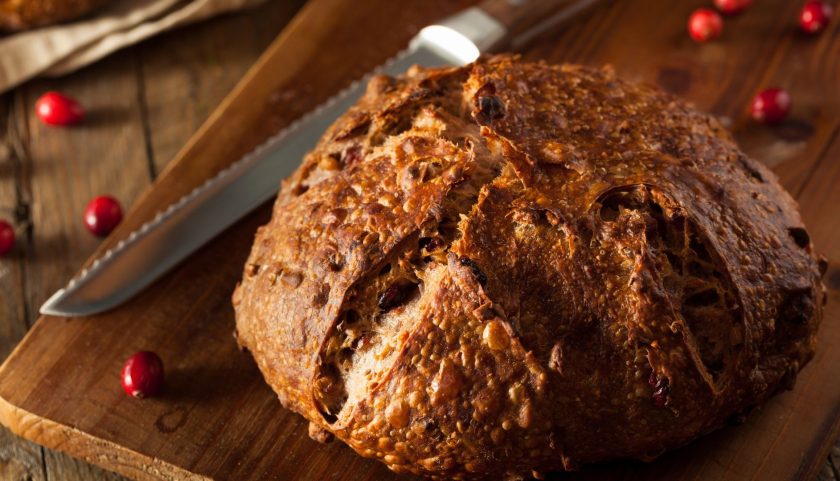
Tips for the Best Cranberry Walnut Loaf
- Toast the nuts. Raw walnuts taste flat and a little bitter. A few minutes in the oven makes them sweet and crunchy.
- Use rice flour in the banneton. It doesn’t absorb into the dough like wheat flour, so your loaf releases cleanly.
- Keep the dough warm. Starters love 75 to 78°F (24 to 26°C). In a chilly kitchen, try the oven with just the light on.
- Bake it cold. Scoring dough straight from the fridge gives cleaner cuts and a better rise.
Troubleshooting
| Problem | Likely cause | Fix |
|---|---|---|
| Dense, tight crumb | Underproofed or sluggish starter | Extend bulk until the dough is puffy and jiggly; feed your starter twice before baking |
| Loaf spreads or collapses when turned out | Overproofed (often from a warm kitchen or proofing at room temperature overnight) or loose shaping | End bulk at a 50 to 75% rise, proof the shaped loaf in the fridge only, and shape more tightly |
| Burnt spots on top | Exposed fruit on the surface | Tuck add-ins under the dough when shaping |
| Gummy middle | Sliced too soon or underbaked | Bake to 205°F (96°C) and cool at least 2 hours |
| Fruit clumped in one spot | Added too late or not folded through | Add at set 2 and spread it evenly before folding |
Easy swaps
- Nuts: pecans, hazelnuts or pistachios work just as well. For nut-free, use toasted pumpkin seeds.
- Dried fruit: swap the raisins for chopped apricots, figs or dates. Keep the total fruit at about 140 g.
- Sweetener: honey, maple syrup or brown sugar all work. Skip it for a more savory loaf.
- Flour: replace up to 100 g of the bread flour with whole wheat or spelt for a nuttier flavor. Add 10 to 15 g extra water, as whole grains are thirstier.
- Spice: add 1 tsp cinnamon with the salt for a cozy, festive twist.
How to store it
| Where | How long | How |
|---|---|---|
| Counter | 3 to 4 days | Cut side down on a board, or in a bread bag |
| Freezer | Up to 3 months | Slice first, wrap well, toast straight from frozen |
Skip the fridge. It dries bread out faster than the counter does.
Ways to Enjoy Cranberry Walnut Sourdough
This loaf is happy at breakfast, lunch or on a cheese board. A few favorites:
- Toasted with salted butter and a drizzle of honey
- With cream cheese and a little orange marmalade
- Turkey and brie sandwich with a smear of cranberry sauce (leftover heaven)
- French toast made with slightly stale slices
- On a cheese board next to aged cheddar, goat cheese or blue cheese
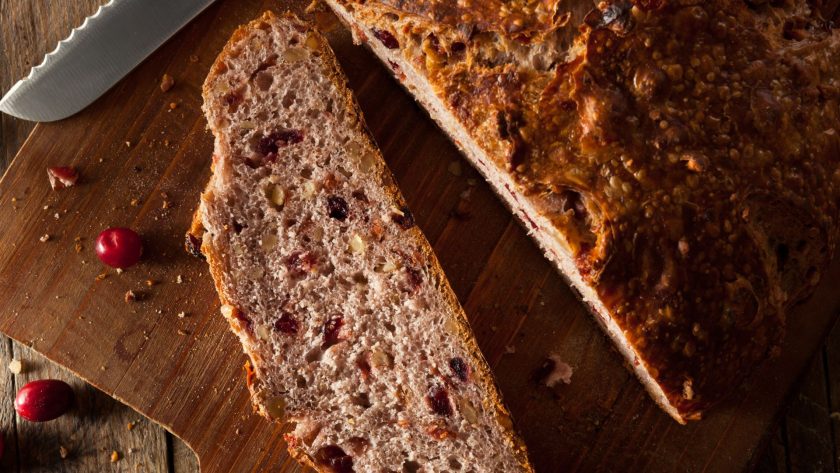
Other Sourdough Recipes
If you’re a fan of sweet sourdough discard recipes, then you’ll love these:
Scrummy Sourdough Cranberry Bread
The secret to a delicious loaf is precision, patience, and of course love for sourdough baking.
When you have your mature starter, there’s no telling what you can make with it.
Experiment with a variety of ideas, to produce a bunch of scrummy treats, for you and your family to enjoy!
Cranberry Walnut Sourdough Bread – FAQs
Can I use fresh or frozen cranberries instead of dried?
You can, but expect a tarter, wetter loaf. Use 80 g of roughly chopped fresh or frozen cranberries (no need to thaw), toss them in 1 tbsp sugar, and add them at the final fold. Reduce the water by about 15 g to make up for the extra moisture.
Can I make this with sourdough discard?
Discard on its own is too sluggish to rise a loaf like this. You need an active, recently fed starter. If you only have discard, feed it once or twice until it doubles reliably within 4 to 8 hours.
Can I bake this without a Dutch oven?
Yes. Bake on a preheated baking stone or heavy baking sheet, and place a metal tray on the rack below. When the bread goes in, pour a cup of boiling water into the tray to create steam. Remove the tray after 20 minutes and finish baking as normal.
Why is my cranberry sourdough so sour?
A long, cold proof and a very ripe starter both boost tang. For a milder loaf, use your starter at its peak (not past it) and keep the fridge proof closer to 8 hours.
What is San Francisco style sourdough?
Black canyon sourdough bread is a San Francisco style sourdough bread, which is basically a French bread made with a sourdough culture.
Can I add almond flour to sourdough?
Yes, in small amounts. Swap up to 50 g (10%) of the bread flour for almond flour to add richness and a subtle nutty flavor, which pairs nicely with the walnuts. Almond flour has no gluten, so go easy: too much leaves you with a dense, crumbly loaf.
Keep in mind that adding almond flour won’t make wheat-based sourdough gluten free or truly low carb. Those need a different recipe built around gluten-free flours.
Can I add oil to my sourdough bread?
You can add olive oil to your sourdough bread, and this will result in a softer crust and crumb.