
Last updated on August 12th, 2026
If you bake sourdough once or twice a week instead of every day, you don’t need the rigid feeding schedule that pops up in most starter guides. Those routines are built for bakers who feed twice daily and bake constantly. For everyone else, a few adjusted ratios and a little fridge time will keep your starter alive and ready without turning it into a part-time job.
We’re here to get into what feeding ratios actually mean, which ones fit a casual schedule, and how to adjust based on how often you bake.
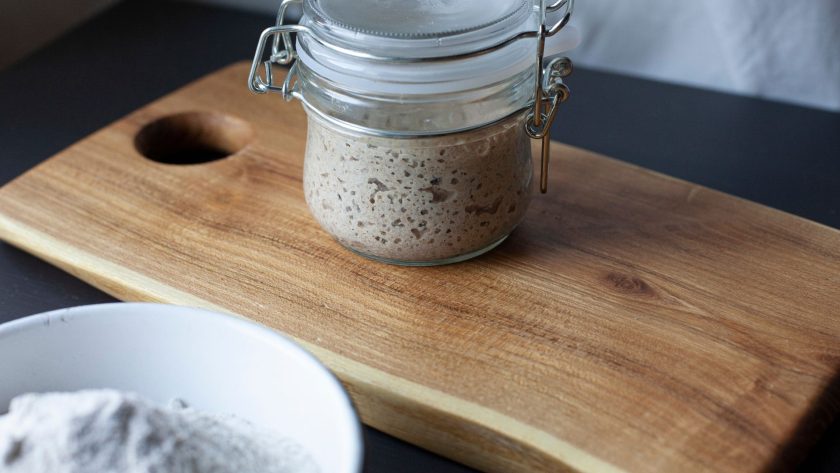
Here’s a Quick Reference for Casual Bakers
- Bake weekly or less: 1:5:5 or 1:10:10, stored in the fridge between feeds
- Bake every few days: 1:2:2, kept at room temperature or a cool spot
- Waking up a fridge starter before baking: 1:1:1 at room temperature, 4-8 hours before use
- Not sure what to use: start with 1:2:2 and adjust based on how your starter behaves over a few weeks
What a Feeding Ratio Actually Means
A feeding ratio describes the relationship between three things: your existing starter, the flour you add, and the water you add. It’s usually written as starter : flour : water.
So a 1:1:1 ratio means equal parts of all three by weight. If you keep 50 grams of starter, you’d add 50 grams of flour and 50 grams of water.
The ratio changes two things:
- How fast your starter ferments. More flour and water relative to starter means a longer rise before it’s ready to use.
- How long your starter stays active before it needs feeding again. A bigger ratio gives the yeast and bacteria more food to work through, which stretches out the time between feedings.
For daily bakers, a small ratio like 1:1:1 works fine because they’re feeding again soon anyway.
For casual bakers, a larger ratio buys more time between feedings, which matters a lot more than always getting a textbook-perfect rise.
Common Sourdough Starter Feeding Ratios and What They’re Good For
| Ratio | Time to peak (room temp) | Good for | Notes |
|---|---|---|---|
| 1:1:1 | 4-6 hours | Daily bakers, same-day feeding | Rises fast, falls fast, needs frequent attention |
| 1:2:2 | 6-8 hours | Baking every 2-3 days | A comfortable middle ground for most home bakers |
| 1:5:5 | 8-12 hours | Weekly bakers | Slower rise, more forgiving if you’re late feeding it |
| 1:10:10 | 12-24 hours | Occasional bakers, larger batches | Uses less discard buildup, good before a baking day |
These times will shift depending on your kitchen temperature. A warm kitchen in summer speeds everything up. A cold kitchen in winter slows it down, sometimes by several hours.
Picking a Starter Feeding Ratio Based on Your Schedule
You might fall into one of three patterns.
Here’s what tends to work for each:
- You bake once a week or less Keep your starter in the fridge and feed it at a 1:5:5 or 1:10:10 ratio the day before you plan to bake. The larger ratio means less discard to deal with between bakes, and the fridge slows fermentation so you’re not racing against a clock.
- You bake every few days A 1:2:2 ratio kept at room temperature or in a cool spot works well here. It gives you a predictable rise time without demanding daily feedings.
- Your schedule is unpredictable Store your starter in the fridge and feed it once a week regardless of whether you’re baking that week. Use a 1:5:5 ratio for that maintenance feeding. When you know you’ll bake in the next day or two, pull it out and give it a fresh 1:1:1 feed at room temperature to wake it back up.
A Weekly Sourdough Starter Feeding Routine That Works
Here’s a routine that works for most people who bake once or twice a week and don’t want to think about their starter every day.
- Sunday: Feed your starter at 1:5:5 and leave it on the counter for 2 hours before moving it to the fridge.
- Rest of the week: Leave it alone in the fridge.
- Day before baking: Take the starter out, discard all but 20-30 grams, and feed it 1:1:1. Let it sit at room temperature.
- Baking day: Once it’s doubled and passes the float test (a small spoonful floats in water), use what you need for your recipe and feed the rest for next time.
This routine keeps your starter fed roughly once a week for maintenance, with one extra feed before an actual bake. That’s two feedings a week instead of fourteen.
Solutions to Common Sourdough Starter Feeding Issues
| Problem | Likely cause | Fix |
|---|---|---|
| Starter smells like nail polish or acetone | It’s hungry and has run out of food | Feed sooner, or increase your ratio next time |
| Starter isn’t rising much | Too cold, or the ratio is too large for how active your starter is | Move to a warmer spot, or drop to a smaller ratio like 1:2:2 |
| Liquid pooling on top (hooch) | Starter has gone past its peak | Pour off the liquid and feed as usual, it’s not harmful |
| Starter takes days to double after fridge storage | Normal after long fridge storage | Give it two or three feedings in a row at room temperature to build strength back up |
| Too much discard building up | Ratio is too small for your feeding frequency | Switch to a larger ratio like 1:5:5 or 1:10:10 |
Adjusting for Flour Type
Whole wheat and rye flours ferment faster than white flour because they carry more of the natural yeast and bacteria already present in the grain. If you’re using any whole grain flour in your feedings, you can often get away with a slightly smaller ratio or a shorter wait time than the chart above suggests. Start checking your starter about an hour earlier than usual and adjust from there.
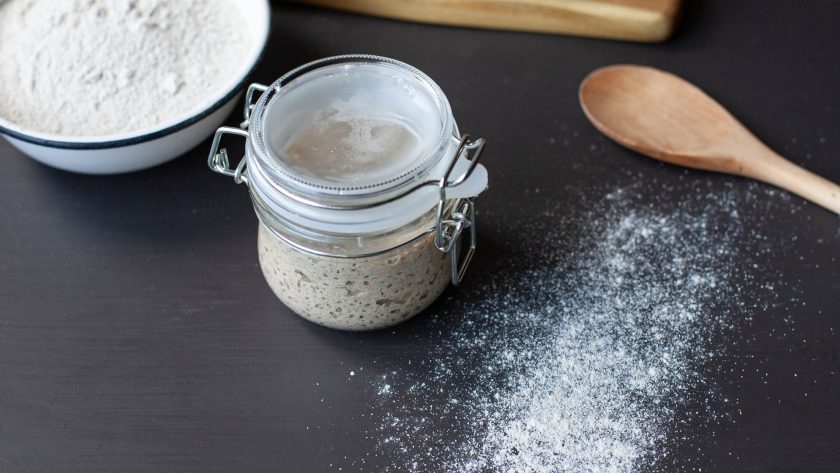
Trust What You’re Seeing More Than the Numbers
Ratios are a starting point only though, not a rulebook.
Two starters fed the same way at the same time can behave differently depending on the flour, the water, and the microbes that happen to live in your kitchen. Watch how your starter rises and falls, smell it, and adjust the ratio up or down based on what actually happens in your kitchen rather than sticking to a number because a guide said so.
Once you’ve fed it a few times on a schedule that matches how often you bake, you’ll stop measuring so carefully and start recognizing what a happy starter looks like on sight.
FAQ
Can I use a different ratio than what a recipe calls for?
Yes. Recipes usually suggest a ratio that matches an assumed baking frequency, not a strict requirement. If you feed at 1:5:5 instead of the 1:1:1 a recipe lists, just plan on a longer wait before your starter peaks.
Do I need to feed my starter every day?
No, not if it’s in the fridge. Cold temperatures slow fermentation way down, so a weekly feeding is enough to keep a refrigerated starter healthy.
What happens if I forget to feed it for two weeks?
Most starters can handle it, especially in the fridge. It may look sluggish or develop a layer of dark liquid on top when you check on it. Pour off the liquid, feed it once, and give it a day or two to bounce back before you rely on it for baking.
Is a bigger ratio always better for casual baking?
Not always. A bigger ratio stretches out the time between feedings, but it also means a longer wait for your starter to peak and a weaker rise if your starter isn’t very active yet. If your starter seems sluggish, drop back to a smaller ratio like 1:2:2 until it strengthens.
Can I switch flours in my feedings?
Yes, switching between white, whole wheat, or rye is fine. Just expect the fermentation speed to change slightly, since whole grain flours tend to ferment faster.
Do I need to discard starter every time I feed it?
Not always, but it helps keep the amount manageable and keeps the ratio accurate. If you skip discarding, you’re effectively feeding a much smaller ratio than the numbers suggest, since your existing starter volume keeps growing.
How do I know my starter is ready to bake with?
Look for it roughly doubled in size with a domed or slightly bubbly top. The float test works too: drop a small spoonful into water, and if it floats, it’s active enough to use.




![[video] from the seed to the peasant bakery with nicolas supiot](https://www.mydailysourdoughbread.com/wp-content/uploads/2022/11/image-16-120x120.jpeg "[Video – Part 2] Entering Into Peasant Bakery 7")

Hi Natasha,
I also have a sensitivity to commercial yeast and had the same symptoms you did. You’re the only other person I’ve run into that has that. I was so thankful when I finally tried homemade sourdough a few months ago and had no reaction! I’ve been loving it. I bake every week. I haven’t had bread for the past 3 years and I forgot how much I missed it. Thank you fir all the wonderful tips and tricks in your blog. It is very helpful.
Amanda
Grand Rapids,MI USA
So happy to read this, Amanda!