
Last updated on August 12th, 2026
If you’ve been keeping a sourdough starter for more than a few weeks, you’ve probably noticed its rise times shift. A starter that doubled in 4 hours during week two might now do it in 6, or in 2. That’s not your imagination, and it’s not a sign you’re doing something wrong.
Starter age changes the microbial makeup of the culture, and that changes how fast (and how predictably) it rises.
Let’s discuss what’s actually happening inside your jar at different ages. How long you should expect rises to take? This is how to read your starter’s behavior instead of simply following a calendar.
Why Age Changes Rise Speed in the First Place
A starter isn’t one organism, it’s a small ecosystem of wild yeast and lactic acid bacteria living off flour and water.
When you first mix a starter, dozens of yeast and bacteria strains show up. Thing is, most of them don’t survive the acidic environment that develops over the first couple of weeks.
By the time a starter is a few weeks old, the weaker strains have died off and a smaller, more resilient population has taken over. That population is what gives you consistent and faster rises.
A brand new starter doesn’t have this yet, so its behavior is genuinely random from one day to the next.
What Actually Slows Down an Old Starter
If your starter has been around for months or years and suddenly seems sluggish, age usually isn’t the cause.
Check these first:
- Feeding ratio got too generous. Feeding 1:5 or 1:10 instead of 1:1 or 1:2 dilutes the yeast population and stretches out rise time.
- Starter is too cold. A starter kept in a fridge below 40°F basically pauses. Even room temp swings of 10 degrees can add hours to a rise.
- Flour changed. Switching from whole wheat or rye (which feed yeast faster) to all-purpose white flour will slow things down.
- It’s underfed or overfed relative to your schedule. A starter fed once a week at room temperature will behave very differently than one fed daily.
- Hydration shifted. A thicker (lower hydration) starter often rises slower than a loose, high-hydration one, even at the same age.
If you rule these out and rise times are still crawling, the starter may genuinely need a reset: a few days of frequent, small feedings (1:1:1 ratio, twice a day) to rebuild yeast population.
Rise Times by Starter Age
| Starter Age | Typical Peak Time (Room Temp, ~72-75°F) | What’s Happening |
|---|---|---|
| Days 1-4 | No real rise, or a false rise that deflates | Bacteria and yeast populations are unstable, competing for dominance |
| Days 5-10 | 8-12+ hours, inconsistent | Wild yeast is establishing itself but strains haven’t stabilized |
| Days 10-21 | 6-10 hours | Yeast and lactic acid bacteria are settling into a working ratio |
| 3-8 weeks | 4-6 hours | Culture is maturing, rises become more repeatable |
| 2-6 months | 3-5 hours | Established colony, consistent and reliable rise |
| 6 months – 2 years | 3-5 hours, stronger flavor | Peak balance of speed and sourness for most bakers |
| 2+ years | 3-6 hours, can slow slightly | Very stable but may need feeding tweaks to stay fast |
These numbers assume regular feeding and a warm kitchen.
Cold, sluggish starters or ones on an irregular feeding schedule will run slower at any age.
Starter Age Milestones, In Order
Days 1-4: The Chaos Phase
You might see bubbles and even a rise in the first 24-48 hours. Ignore it. This is usually a burst of gas-producing bacteria (not the yeast you want) and it typically collapses within a day. This isn’t a working starter yet, even if it looks active.
Days 5-10: Yeast Starts Showing Up
Around day 5, true wild yeast usually begins to establish itself. Rises become real but wildly inconsistent, sometimes 8 hours, sometimes not rising at all before your next feed. This is normal. The colony is still sorting itself out.
Days 10-21: Stabilizing
By the two to three week mark, most starters rise predictably within a 6-10 hour window after feeding. This is the point where a lot of recipes will say your starter is “ready,” but it’s still young and will keep improving in speed and strength.
3-8 Weeks: Getting Reliable
This is usually where home bakers start trusting their starter for actual bread. Rise times tighten up to 4-6 hours, and the float test (dropping a spoonful in water to see if it floats) becomes a reliable indicator rather than a coin flip.
2 Months and Beyond: Mature and Consistent
A starter that’s been fed consistently for two months or more has a settled microbial community. Rise times land in a narrow window most days, and you’ll start noticing flavor development too, more complexity, more tang, depending on your feeding ratio and hydration.
6 Months to 2+ Years: The Sweet Spot
Many experienced bakers consider a starter between six months and a couple of years old to be in its prime: fast, dependable, and full-flavored. Some very old starters (decades, even over a century in a few famous cases) are prized more for flavor complexity and story than for speed. Age alone doesn’t make a starter better forever, consistency of care matters more past a certain point.
How to Track Your Starter’s Rise Time Without Guessing
A rubber band or a marker line on the jar works better than eyeballing it.
Here’s a simple method:
- Feed your starter and note the time.
- Mark the starting level on the jar with a rubber band or tape.
- Check every hour or two and mark when it hits double.
- Note the time it took, and whether it’s still rising, peaked, or starting to collapse (look for a domed top sinking in the middle).
- Log it. Even a note on your phone with date, feeding ratio, and time-to-peak builds a pattern you can actually use.
After two or three weeks of logging, you’ll have a real baseline for your specific starter, kitchen, and flour, which is far more useful than any generic chart.
Does an Older Starter Always Rise Faster?
Not necessarily, and this trips people up.
Rise speed depends more on the health and activity level of the yeast population than on the calendar age of the starter. A 3-year-old starter that’s been neglected in the fridge for a month will rise slower than a well-fed 6-week-old starter. Age gives a culture the chance to stabilize, but ongoing care is what keeps it fast.
A starter that’s regularly “exercised” (fed and used) stays strong regardless of how long you’ve had it. One that sits idle loses conditioning, no matter its age.
Signs Your Starter Is Ready to Bake With (Fast Reference)
- Doubles or more in size within 4-6 hours of feeding
- Passes the float test at or near peak
- Smells pleasantly sour or yeasty, not sharply like nail polish remover or acetone
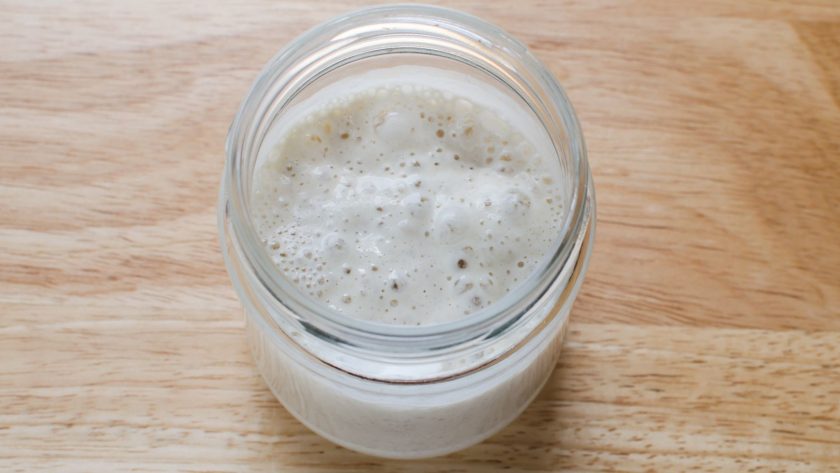
- Has visible bubbles throughout, not just on the surface
- Rise time is roughly repeatable feeding to feeding, not wildly different every day
If your starter checks most of these boxes, its exact age matters less than its current activity level. A young, well-cared-for starter can outperform an old, neglected one on any given day.
FAQs
How old does a starter need to be before I can bake with it?
Most starters are ready to bake with somewhere between 3 and 8 weeks old, once rise times settle into a repeatable 4-6 hour window and it passes the float test. Some starters get there faster, some take longer depending on flour type and feeding schedule.
Why is my 2-week-old starter rising faster than my 2-month-old one?
This usually comes down to feeding consistency, not age. A younger starter fed reliably on a tight schedule can outperform an older one that’s been fed irregularly or kept too cold. Check feeding ratio, temperature, and flour type before assuming age is the issue.
Can a starter be too old to use?
No. As long as it’s still active (bubbling, rising, smelling pleasantly sour) a starter can be decades old and work perfectly fine. Some of the most well known starters in bakeries are well over 50 years old. Neglect, not age, is what kills a starter’s performance.
Should rise time get faster forever as a starter ages?
No. Rise time typically improves for the first couple of months, then levels off. Past that point, speed depends much more on feeding ratio, hydration, temperature, and flour than on how many more months or years go by.
How often should I feed my starter to keep rise times consistent?
For room-temperature starters, once or twice a day at a 1:1:1 ratio (equal parts starter, flour, and water by weight) keeps yeast activity steady. If you keep it in the fridge, a weekly feeding is usually enough, but expect a slower rise for a day or two after taking it back out to room temperature.
Why did my starter suddenly slow down after being reliable for months?
Look at recent changes first: a new bag of flour, a colder room, a longer gap between feedings, or a change in hydration. Sudden slowdowns are almost always caused by a recent shift in care rather than the starter simply aging out.
Does starter age affect flavor as well as rise speed?
Yes. Older, well-maintained starters often develop more complex tang and depth of flavor over months, even after rise speed has already leveled off. This is one reason some bakers keep the same starter going for years rather than starting fresh.
Related Articles:
 Easy Sourdough Starter (A No-Fuss Guide for Beginners)
 Strawberry Cinnamon Rolls Recipe: A Sweet Twist on a Classic Favorite
 Sourdough Cinnamon Banana Bread: Easy, Moist & Delicious Recipe
 How to Use Sourdough Starter Like a Pro (Even as a Beginner)
 How to Rehydrate Sourdough Starter: Step-by-Step Guide for Beginners
